ICR Calculator (USA) — Advanced
Income-Contingent Repayment – ICR Calculator: Estimate Your Payments & Forgiveness
Managing federal student loans requires staying ahead of constantly shifting federal laws. The ICR calculator is designed to estimate your monthly payments using official Income-Contingent Repayment guidelines. Under this plan, your monthly bill is capped at the lower of two amounts: 20% of your discretionary income, or an adjusted payment based on a 12-year standard repayment plan.
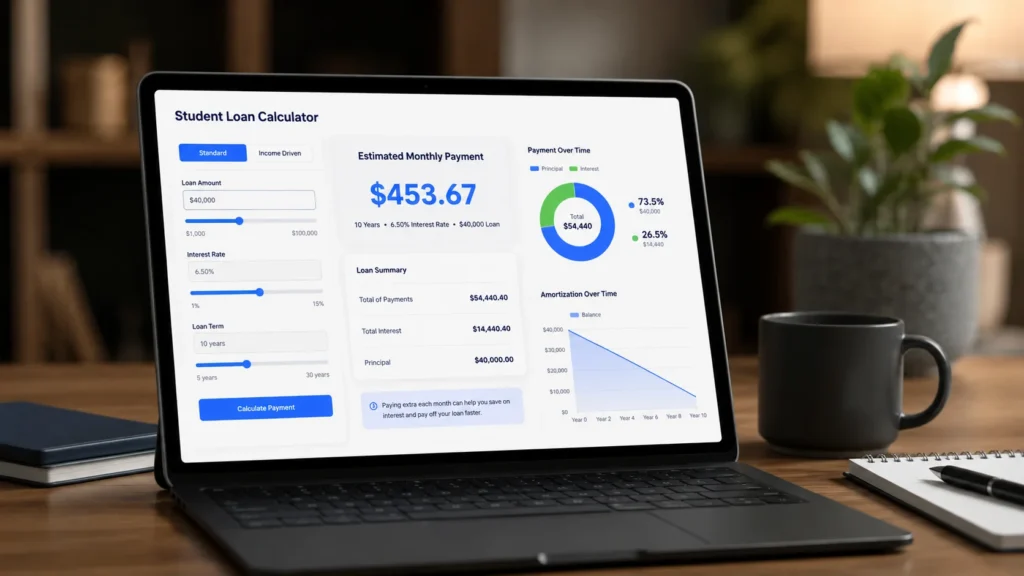
By using our interactive icr loan calculator, you can enter your subsidized or unsubsidized loan balances, interest rates, Adjusted Gross Income (AGI), household size, and expected income growth. This allows you to instantly project your monthly payment, track total interest, view a complete amortization schedule, and forecast your potential forgiven balance after 25 years of qualifying payments.
⚠️ Critical 2026 Policy Update: The federal student loan ecosystem is undergoing a massive overhaul. The ICR plan will stop accepting new loans starting July 1, 2026. Furthermore, the ICR framework will be completely eliminated by July 1, 2028. Existing borrowers currently using ICR will need to transition to alternative options, such as the new Repayment Assistance Plan (RAP), before the sunset deadline
Table of Contents
What Is Income-Contingent Repayment (ICR)?
Income-Contingent Repayment (ICR) is a legacy federal student loan repayment program that adjusts your required monthly obligation based on your active income, family size, and total outstanding loan balance.
When you calculate icr metrics, the government evaluates two distinct calculations:
- The Discretionary Income Method: 20% of your calculated discretionary income.
- The 12-Year Standard Method: A fixed monthly payment structured over a 12-year amortization schedule, adjusted dynamically for your income level.
The federal system automatically bills you for the lesser of these two amounts, ensuring you always get the most affordable rate available under the plan.
Who is the ICR Plan Best For?
Historically, the ICR framework has been a critical safety net for individuals who do not qualify for alternative income-driven plans—particularly Parent PLUS loan borrowers who have strategically combined their debt into a Direct Consolidation Loan. If standard 10-year repayment plans are financially unviable, this option delivers much-needed, income-based relief.
Note: Under rules taking effect July 1, 2026, new Parent PLUS loans will be completely restricted from income-driven structures, capping annual and lifetime borrowing limits.
How an ICR Payment Calculator Works
To understand exactly how your monthly obligations are determined, the icr payment calculator runs a direct comparison between two distinct financial paths:
1. The 20% Discretionary Income Option
First, your discretionary income is established using your household size and financial data via the following federal formula:
$$\text{Discretionary Income} = \text{AGI} – (150\% \times \text{Federal Poverty Guideline for Household Size})$$
From there, your maximum monthly baseline is calculated:
$$\text{Monthly Option} = \frac{\text{Discretionary Income} \times 20\%}{12}$$
2. The 12-Year Standard Payment Option
Alternatively, the plan calculates a fixed payment based on a 12-year amortization schedule suited to your total loan balance. A weighted average interest rate across all your combined student loans is utilized to approximate this figure.
The Golden Rule of ICR: Your final monthly payment will always equal the lower value between the 20% discretionary calculation and the 12-year standard schedule.
A Note on Interest Accrual and Subsidies
If your calculated monthly payment doesn’t cover the monthly interest accruing on your debt, the unpaid interest will accumulate. Depending on federal guidelines, this interest may eventually capitalize. Our tracking tool models standard federal subsidy behaviors, meaning subsidized loans receive partial interest accrual relief during their first 36 months on the plan.
Why You Should Use an ICR Loan Calculator
Running your numbers through an advanced icr repayment tracking tool offers several distinct strategic advantages:
- Compare Payment Options Instantly: Visually verify whether 20% discretionary income or a 12-year amortization pathway rewards you with the lowest monthly out-of-pocket cost.
- Accurately Forecast Forgiveness: The ICR plan provides complete balance forgiveness after 25 years of qualifying monthly payments. The calculator helps you estimate your remaining forgiven balance.
- Model Future Income Shifts: Seamlessly input anticipated annual salary or income growth percentages to preview how your future payments will adjust over time.
- Master Long-Term Costs: Evaluate your total interest paid over a 25-year timeline against alternative strategies, such as aggressive principal payoff or private refinancing.
Real-World Strategic Scenarios
Scenario A: Low Income, Large Loan Balance
- Profile: $35,000 AGI, 1-person household, $80,000 total balance at 6.0% interest.
- Outcome: The 20% discretionary income calculation will generate a low monthly payment, significantly undercutting a 12-year standard payment. Interest will accumulate over time, but the substantial remaining balance can be completely forgiven after the 25-year term concludes.
Scenario B: Higher Income, Moderate Loan Debt
- Profile: $85,000 AGI, 1-person household, $60,000 total balance at 5.5% interest.
- Outcome: The 12-year standard amortization option will likely sit lower than the 20% discretionary income calculation. The ICR system will automatically select this 12-year payment. While your monthly payment will be higher, you will clear the debt over a shorter timeline, drastically lowering your total lifetime interest costs.
Evaluating the Pros and Cons of ICR
The Benefits (Pros)
- Provides immediate payment relief for borrowers navigating lower income brackets.
- Guarantees total federal loan forgiveness after 25 years of qualifying payments.
- Offers complete flexibility, adjusting up or down as your annual earnings change.
The Drawbacks (Cons)
- The 20% discretionary income threshold is higher than alternative income-driven repayment plans like the previous SAVE framework.
- Because payments can be lower than interest generation, total interest paid over the life of the loan can skyrocket.
- Forgiven loan balances could potentially be treated as taxable income depending on current tax legislation at the time of forgiveness.
Practical Tips for Success on the ICR Plan
- Recertify Your Income Annually: To remain active on the plan and prevent default, you must submit your updated income and household verification every single year without fail.
- Prepare for the Sunset Window: Because ICR will completely phase out by July 1, 2028, use this time to compare your numbers against the new Repayment Assistance Plan (RAP).
- Approach Consolidation with Care: Consolidating older Parent PLUS loans is the primary way to unlock ICR eligibility, but be aware that this action can reset your existing progress toward qualifying forgiveness periods. Parent PLUS consolidation must be initiated immediately to preserve income-driven options.
- Make Strategic Extra Payments: If your cash flow increases, consider making targeted, extra payments directly toward your loan principal to systematically reduce long-term interest buildup.
Is Private Refinancing a Better Alternative?
If you possess a highly stable income and can successfully qualify for a lower interest rate through a private lender, refinancing can be a viable way to save money. However, proceed with extreme caution: refinancing federal student loans into private loans permanently eliminates your access to flexible federal programs, income-contingent safety nets, and all federal forgiveness benefits. Evaluate both paths comprehensively before finalizing your decision.
Freqeuntly Asked Questions:
Q1: What is the main purpose of the ICR plan?
A: The Income-Contingent Repayment (ICR) plan is designed to make federal student loan repayment manageable by capping your monthly bill at the lesser of 20% of your discretionary income or a fixed 12-year amortization payment. Any remaining debt balance is entirely forgiven after 25 years of qualifying payments.
Q2: How do I calculate icr discretionary income?
A: Discretionary income under this plan is calculated by taking your Adjusted Gross Income (AGI) and subtracting 150% of the official federal poverty guideline corresponding to your specific household size. An official icr payment calculator handles this complex formula automatically to deliver quick, accurate estimates.
Q3: Can I use an icr loan calculator for Parent PLUS loans?
A: Parent PLUS loans are not directly eligible for the ICR plan in their original state. However, if a borrower combines older eligible loans into a federal Direct Consolidation Loan, the consolidated balance can then become eligible for repayment under the ICR framework. Note that strict new limits apply to loans issued after July 1, 2026.
Q4: Exactly how many years does it take to get forgiveness under ICR?
A: The standard timeline to achieve complete debt forgiveness under the federal ICR program is 25 years of qualifying, on-time monthly payments.
Q5: Will unpaid interest accumulate while I am on the ICR plan?
A: Yes. If your income-linked payment is lower than the interest accruing on your account balance each month, that unpaid interest will accrue. Our icr loan calculator integrates standard federal subsidy models, which offer partial interest accrual relief on subsidized loans during the first 36 months of repayment.
Q6: Is the loan balance forgiven under ICR subject to income tax?
A: Federal and state tax treatments regarding forgiven student loan debt are subject to legislative changes. It is highly recommended to check current IRS guidance or consult directly with a certified tax professional to understand your potential tax liability at the end of your 25-year term.