Parent PLUS Loan Calculator
| Period | Standard Payment | Principal Paid | Interest Paid | Remaining Principal | Total Cost Progress |
|---|
| Period | Extended Payment | Principal Paid | Interest Paid | Remaining Principal | Total Cost Progress |
|---|
Parent PLUS Loan Calculator: True Cost & Repayment Estimator
Planning for your child’s higher education is a profound milestone, but navigating the real cost of federal borrowing requires institutional-grade precision. Many families rely on a standard parent plus loan monthly payment calculator only to discover hidden out-of-pocket expenses later.
When you borrow a Federal Direct Parent PLUS Loan, the money sent to the bursar’s office is not the amount you eventually have to pay back. Because of a mandatory federal origination fee and continuous in-school interest capitalization, your debt expands before your child even graduates.
Our interactive Parent PLUS Loan Calculator was designed from the ground up to solve this transparency issue. By mapping the exact 4.228% federal gross-up formula alongside multi-term amortization schedules, this tool reveals your true repayment reality instantly. Let’s break down the underlying math, the structural traps, and the strategic repayment plans you need to master to safeguard your family’s financial future.
Table of Contents
Understanding the True Borrowing Target: The Gross-Up Trap
The most significant mistake families make when planning for college billing cycles is borrowing exactly what the university requests on the financial aid award letter. If the school requires a net funding balance of $45,000, and you apply for $45,000, you will fall short.
The U.S. Department of Education deducts a mandatory 4.228% origination fee upfront from every single selection cycle. To ensure the school receives the exact amount required to cover tuition, housing, and institutional fees, you must execute a “gross-up” calculation.
To ensure you are calculating your upfront requirements accurately, verify the latest historical and current fees directly on the U.S. Department of Education Federal Student Aid Portal. When you borrow a Federal Direct Parent PLUS Loan, the money sent to the bursar’s office is not the amount you eventually have to pay back…
Our Parent PLUS Loan Calculator handles this automatically using the following structural formula:
$$\text{Gross Loan Amount} = \frac{\text{Net Funding Needed}}{1 – 0.04228}$$
Real-World Example
If your net tuition balance is exactly $45,000, the true amount you must borrow is:
$$\text{Gross Loan Amount} = \frac{45,000}{0.95772} = \$46,986.59$$
The missing $1,986.59 is the federal origination fee. The government keeps this fee immediately upon disbursement, while you remain legally responsible for paying back the full $46,986.59 plus interest.
| Metric Component | Standard Request Approach | Advanced Gross-Up Strategy |
| Net School Disbursement | $43,097.40 (Shortfall!) | $45,000.00 (Full Coverage) |
| Upfront Origination Fee (4.228%) | $1,902.60 | $1,986.59 |
| Total Stated Principal Debt | $45,000.00 | $46,986.59 |
The Compounding Cost of In-School Deferment
Parent PLUS Loans carry a fixed interest rate that begins accumulating the moment the funds are sent to the school. Borrowers have the option to defer payments while their child is enrolled at least half-time and for an additional six-month grace period. However, “deferred” does not mean “interest-free.”
During this in-school period, the loan accumulates unsubsidized simple interest. Our calculator estimates this milestone using an annual timeline:
$$\text{Annual Interest Accrual} = \text{Gross Loan Amount} \times \left( \frac{\text{Annual Loan Rate}}{100} \right)$$
$$\text{Total Accrued In-School Interest} = \text{Annual Interest Accrual} \times \text{In-School Years}$$
⚠️ The Capitalization Trap
When your deferment ends, all accumulated, unpaid in-school interest is added directly to your original gross principal. This event is called capitalization. Moving forward, your monthly payment is calculated based on this brand-new, larger balance. You are now paying interest on top of interest.
Read the official guidelines regarding how interest accrues and compounds on the Federal Student Aid Interest Rules Page. When your deferment ends, all accumulated, unpaid in-school interest is added directly to your original gross principal…
Continuing with our example at a current historically reflective interest rate of 9.07% over 4 years of undergraduate study:
- Annual Interest Accrual: $\$46,986.59 \times 0.0907 = \$4,261.68$ per year
- Total Accrued Interest: $\$4,261.68 \times 4 = \$17,046.74$
- New Capitalized Principal Basis: $\$46,986.59 + \$17,046.74 = \$64,033.33$
By waiting until graduation to make your first payment, your starting balance has naturally expanded by over 42%.
Amortization Formulas: How Payments Are Computed
To calculate parent plus loan payment trajectories across distinct timelines, our software evaluates a monthly periodic rate ($r$) where $r = \left(\frac{\text{Annual Rate}}{100}\right) / 12$. The total number of repayment months is represented by $n$ (years $\times 12$).
The exact mathematical equation used by the system to establish your fixed Monthly Payment ($M$) is:
$$M = \frac{P \cdot r \cdot (1 + r)^n}{(1 + r)^n – 1}$$
Where:
- $M$ = Standard Monthly Payment
- $P$ = New Capitalized Loan Balance at Repayment Entry
- $r$ = Periodic Monthly Interest Rate (Decimal)
- $n$ = Total Amortization Months
Handling the 0% Corner Case
If an interest rate drops to zero percent due to legislative adjustments, the standard formula breaks because of a division-by-zero error. Our system uses a safety fallback rule:
$$\text{If } r = 0, \quad M = \frac{P}{n}$$
Floating-Point Balancing
In raw financial script architectures, sequential subtractions like $\text{Balance} – \text{Principal Paid}$ routinely drift due to floating-point rounding errors, creating tiny negative remnants like $-\$0.000001$. The underlying engine prevents this by bounding the final step:
$$\text{Remaining Balance} = \max(0, \text{Previous Balance} – \text{Current Month Principal})$$
Repayment Alternatives: Standard vs. Extended Tracks
Once your capitalized balance is set, you must pick a path to pay it off. The choice you make has a massive impact on your monthly budget and long-term interest costs.
1. The Standard Repayment Plan (10-Year Horizon)
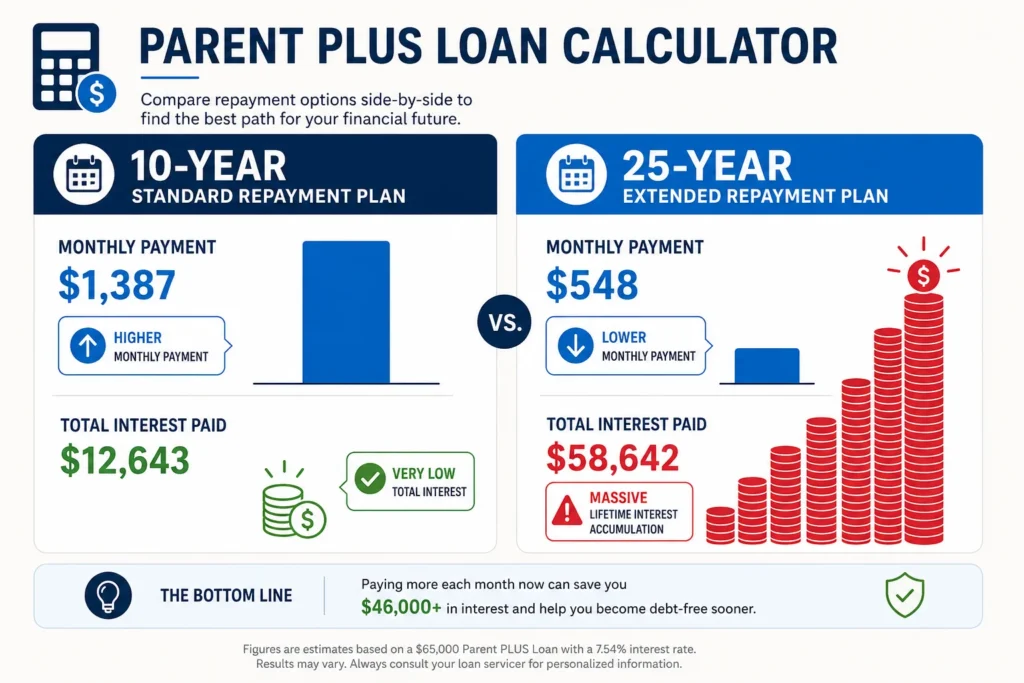
This plan breaks your balance into 120 equal monthly installments. It features the highest monthly payment but saves you the most money over time by eliminating long-term interest accumulation.
2. The Extended Repayment Plan (25-Year Horizon)
Available to borrowers with more than $30,000 in outstanding federal student debt, this plan stretches your schedule to 300 months. While this lowers your immediate monthly bill, the interest builds up over a much longer period.
The table below shows how these two options compare for our $64,033.33 capitalized balance at a 9.07% interest rate:
+───────────────────────────────────────────+────────────────────+────────────────────+
| Amortization Metric Comparison            | Standard (10-Year) | Extended (25-Year) |
+───────────────────────────────────────────+────────────────────+────────────────────+
| Capitalized Base Balance                  | $64,033.33         | $64,033.33         |
| Monthly Payment Installment               | $814.15            | $541.36            |
| Total Amortization Payments (Term End)    | $97,698.15         | $162,408.85        |
| Cumulative Interest Paid Post-Graduation  | $33,664.82         | $98,375.52         |
| Combined Lifetime Debt Outlay             | $99,684.74         | $164,395.44        |
+───────────────────────────────────────────+────────────────────+────────────────────+
Choosing the extended plan reduces your monthly payment by $272.79, but it drives your long-term interest expenses up by an extra $64,710.70. This comparison highlights why using a dedicated parent plus loan monthly payment calculator is so important before signing your loan documents.
Strategic Move: The Parent PLUS Consolidation Loophole
Many borrowers look for a parent plus loan consolidation calculator because they want to access Income-Driven Repayment (IDR) options. By default, Parent PLUS loans are not eligible for student-focused IDR plans like SAVE or IBR.
However, there is a legal strategy known as the Double Consolidation Loophole. By carefully navigating multiple steps, you can turn your parent loans into a standard Federal Direct Consolidation Loan.
Step 1: Divide your Parent PLUS loans into two separate groups.
   │
   ├──> Group A Loans ──> Consolidate via Paper Application ──> Consolidation Loan #1
   └──> Group B Loans ──> Consolidate via Paper Application ──> Consolidation Loan #2
                                                                   │
Step 2: Combine the two new consolidation loans together ──────────┘
   │
   └──> Final Direct Consolidation Loan ──> Unlocks Access to Income-Contingent Repayment (ICR)
By completing this process, your final loan becomes eligible for the Income-Contingent Repayment (ICR) plan. This plan bases your monthly bill entirely on your discretionary income rather than your total debt balance, offering an excellent safety net for parents approaching retirement.
By completing this process, your final loan becomes eligible for the Income-Contingent Repayment (ICR) plan. This plan bases your monthly bill entirely on your discretionary income rather than your total debt balance. You can review the exact eligibility requirements and initiate this process on the Official Federal Student Loan Consolidation Application.
Pro Tips for Effective Parent PLUS Debt Management
- Pay Interest Monthly During School: You do not have to wait for graduation to start making payments. Paying off your interest as it accrues during college prevents it from capitalizing, which saves you thousands of dollars down the road.
- Account for the Origination Fee Upfront: Always use a parent plus loan monthly payment calculator that automatically factors in the 4.228% fee gross-up. This ensures you request enough funding to cover the school’s actual billing statement.
- Watch the Amortization Mechanics: Just like an auto loan, student loan interest is front-loaded. In the early stages of your repayment schedule, the majority of your monthly payment goes toward interest rather than reducing your actual principal balance.
Frequently Asked Questions (FAQs):
What is the current origination fee for Parent PLUS loans?
The federal origination fee for all Federal Direct Parent PLUS loans is a fixed 4.228%. This fee is deducted immediately by the government at disbursement. To receive your desired net funding amount at the school, you must divide your target total by 0.95772 to compute the higher gross application goal.
How does interest capitalize on parent federal loans?
Interest on Parent PLUS loans begins accumulating daily as simple interest from the moment funds are sent to the university. If you choose to defer payments while your child is in school, all accrued, unpaid interest is added directly to the original principal balance at graduation. This increases your overall loan balance and raises your future monthly payments.
Can Parent PLUS loans be transferred directly to the student?
No. Federal Parent PLUS loans are legally tied to the parent who signed the Master Promissory Note (MPN). They cannot be transferred into a federal student loan under the student’s name. The only way to move this debt to a child is through private student loan refinancing, which requires the child to meet private credit and income guidelines and forfeits all federal protections.
Does a parent plus loan consolidation calculator reduce interest rates?
No, a federal direct consolidation loan does not lower your interest rate. Your new fixed rate becomes the weighted average of your existing loans, rounded up to the nearest one-eighth of one percent. To see a complete breakdown of current rates, check the Federal Student Aid Loan Types Directory.