Mortgage Points Calculator
| Time | Base EMI | New EMI | Saving | Net Position |
|---|
Mortgage Points Calculator: Is Buying Discount Points Actually Worth It?
If you have been shopping for a home loan recently, your lender has probably mentioned the option to buy down your interest rate using discount points. It sounds appealing—a lower EMI every month—but there is a catch: you have to pay a lump sum upfront at closing. So the real question is whether it is actually worth it.
That is exactly what a mortgage points calculator is designed to answer. Instead of guessing or relying on generic advice, you can plug in your loan details and instantly see your break-even point, monthly savings, and net gain over the full loan term. This guide walks you through everything you need to know about mortgage discount points, how they work, the math behind them, when buying points makes sense, and how to use our calculator to make a fully informed, data-backed decision.
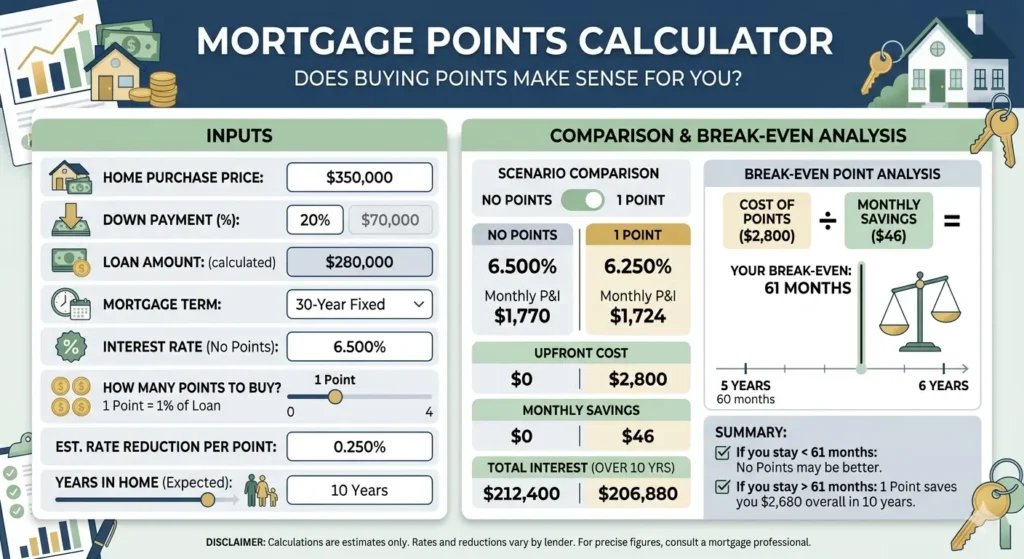
Table of Contents
What Are Mortgage Points? (And Why Should You Care?)
Mortgage points—also called discount points—are essentially a form of prepaid interest. When you buy points at closing, you are paying a fee to your lender in exchange for a permanently lower interest rate on your home loan. Mortgage discount points can help reduce your interest rate over the life of the loan. According to the Consumer Financial Protection Bureau (CFPB), borrowers should compare upfront costs against long-term savings before purchasing points. Some mortgage points may qualify for tax deductions under relevant financial guidelines, depending on your circumstances.
Here is the standard rule of thumb most lenders follow:
1 mortgage point = 1% of the total loan amount = 0.25% reduction in your interest rate
So if you are taking out a $50,000,000 home loan, one point costs $50,000 upfront and reduces your rate by 0.25%. Two points would cost $1,00,000 and reduce your rate by 0.50%, and so on. The logic is straightforward: by paying more now, you pay less every single month for the life of the loan. Whether that tradeoff works in your favour depends entirely on how long you plan to stay in the home, which makes the break-even calculation critical.
Discount Points vs. Origination Points: Don’t Confuse the Two
One common source of confusion is that not all points are the same. There are two distinct types you will encounter during the mortgage process:
- Discount Points: Prepaid interest you pay to reduce your interest rate permanently. These are often tax-deductible as prepaid interest.
- Origination Points: Lender fees charged for processing, underwriting, and executing your loan. They do not reduce your interest rate. They are a transactional cost rather than an investment.
Always clarify with your lender which type of points they are quoting before making any financial commitments.
How Our Mortgage Points Calculator Works
Our calculator uses industry-standard financial formulas to give you a precise, accurate picture of your savings.
Step 1: The EMI Formula
Both your current EMI without points and your new reduced EMI with points are calculated using the standard amortisation formula:
EMI = [P x r x (1 + r)^n] / [(1 + r)^n – 1]
Where:
- P = Principal loan amount
- r = Monthly interest rate (annual rate divided by 12)
- n = Total number of monthly payments
This formula serves as the backbone of every home loan calculation, ensuring the EMI figures you see are completely accurate.
Step 2: The Break-Even Calculation
The break-even point is the single most important number in this analysis. It tells you the exact month at which your cumulative monthly savings will equal the upfront cost of the points. After that month, every payment represents pure savings.
Break-Even (Months) = Total Cost of Points / Monthly EMI Savings
Where:
Monthly EMI Savings = Original EMI – New Lower EMI
For example, if you paid $1,00,000 for two points and your EMI dropped by $2,200 per month, your break-even point is roughly 45 months, or about 3 years and 9 months.
Step 3: Lifetime Savings and Net Gain
Beyond the break-even point, the calculator also computes:
- Lifetime Interest Saved: The total reduction in interest paid over the full loan term, which can run into thousands of dollars on a large, long-tenure loan.
- Net Gain: Lifetime savings minus the upfront cost of the points, representing your true financial return on investment.
How to Use the Mortgage Points Calculator Step by Step
Using the calculator takes less than a minute. Follow these steps to secure the most accurate results:
- Enter your total Loan Amount, representing the principal borrowed rather than the property value.
- Input your Base Interest Rate offered by your lender without any points. Make sure to use the baseline rate rather than an introductory or promotional teaser rate.
- Select your Loan Term, typically 10, 15, 20, or 30 years. A longer term provides more months of savings, which can enhance the value of points.
- Choose how many Points you want to buy using the slider to experiment with 0.5, 1, 1.5, 2 points or more. Each 0.25-point step shifts the financial dynamics.
- Hit Analyse Now and review your results, paying special attention to the break-even period and net gain.
💡 Pro Tip: Run the calculation multiple times with different point values. Buying 1 point often yields 80% of the financial benefit at half the upfront cost of 2 points. Always compare scenarios.
When Is Buying Mortgage Points Actually Worth It?
The honest answer is that it depends heavily on how long you intend to stay in the home.
Strong Case FOR Buying Points
- You plan to live in the home for significantly longer than your calculated break-even period.
- You have surplus cash at closing and do not need to compromise your emergency fund.
- You are taking out a large loan with a long tenure, where compounding savings are substantial.
- Interest rates are high and you do not anticipate refinancing in the near term.
- Your break-even timeline is under 4 years, which is highly favourable.
Strong Case AGAINST Buying Points
- You are likely to move, sell, or refinance within 5 to 7 years.
- The upfront cost would drain your liquidity or force you to take on additional high-interest debt.
- Your break-even period stretches past 7 years, representing a lengthy commitment.
- You are buying in a falling-rate environment where refinancing is likely.
- The seller is offering to cover closing costs, which are better applied to origination fees to preserve cash.
Rule of Thumb: If your break-even period is under 36 months, buy points aggressively. If it is 36 to 60 months, it is worth considering for long-term stays. If it exceeds 60 months, proceed with caution and evaluate carefully before committing capital.
Real-World Scenario: Should Jonathan Buy Discount Points?
Consider Jonathan, who is buying a $60,00,000 house and offered a 9.0% interest rate on a 20-year loan. He is evaluating whether to buy 2 discount points at closing.
| Parameter | Value |
| Loan Amount | $60,00,000 |
| Base Interest Rate | 9.0% |
| Loan Term | 20 years |
| Points Purchased | 2 points |
| Upfront Cost (2%) | $1,20,000 |
| New Interest Rate | 8.5% |
| Original EMI | $53,984 / month |
| New EMI (with points) | $52,076 / month |
| Monthly Savings | $1,908 / month |
| Break-Even Period | ~63 months (5 years 3 months) |
| Lifetime Interest Saved | $4,58,000 |
| Net Gain (after upfront cost) | $3,38,000 |
The Verdict: Jonathan’s break-even point is 63 months. If he stays in the home for 7 or more years, buying points is a smart move that yields substantial net savings. However, if there is any chance he will sell or refinance within 5 years, he should skip the points and keep his $1,20,000 liquid.
Advanced Strategies for Maximising Discount Points
- Fractional Points Work Too: You do not need to buy whole points. Lenders frequently permit purchases of 0.5 or 0.25 points to shorten break-even timelines while still capturing lower EMIs.
- Negotiate Seller Concessions: In competitive real estate markets, you can negotiate for sellers to cover seller concessions, effectively paying for your discount points and eliminating your upfront out-of-pocket costs.
- Evaluate Opportunity Cost: Cash used for points could alternatively be invested in high-yield vehicles. Compare your guaranteed return from points against potential market gains to balance risk and liquidity.
- Combine with Discipline: If you plan to make aggressive prepayments to close your loan early, points may not make sense because you will exit the loan before reaching break-even.
- Factor in Refinancing Probability: Refinancing resets your financial clock. If market rates drop significantly in the future, refinancing will vaporize remaining point savings.
Common Homebuyer Mistakes with Mortgage Points
- Failing to calculate break-even: Never buy points without knowing the exact month you recover your capital.
- Confusing point types: Assuming origination fees lower your interest rate.
- Ignoring liquidity needs: Tying up essential emergency funds in upfront points.
- Buying points on adjustable-rate mortgages (ARMs): Rate resets can render fixed discount benefits obsolete.
- Flipping properties: Short ownership timelines never justify upfront point costs.
Are Mortgage Points Tax-Deductible?
Under standard financial and tax guidelines, discount points are generally treated as prepaid interest and may qualify for deductions depending on your jurisdiction and filing status. For instance, home loan interest can qualify for deductions under specific tax provisions (such as Section 24(b)), and discount points follow similar prepaid interest rules. Always consult a qualified chartered accountant or tax advisor before making decisions based on assumed tax deductibility.
Frequently Asked Questions (FAQs):
How much does 1 mortgage point cost?
One mortgage point costs exactly 1% of your total loan amount. For a $40,00,000 loan, one point costs $40,000, while a $100,000,000 loan makes one point cost $1,000,000.
How much does 1 point reduce my interest rate?
Typically, 1 point reduces your interest rate by 0.25%. A 9.0% loan drops to 8.75% with 1 point and 8.50% with 2 points.
What is a good break-even period?
Under 36 months is excellent. 36 to 60 months is reasonable for long-term homeowners, whereas anything exceeding 60 months requires strict scrutiny.
Can I negotiate discount points?
Yes. While standard pricing dictates 1% per point for a 0.25% reduction, terms can be negotiated or covered via seller concessions in competitive markets.
What happens if I refinance after buying points?
Refinancing before reaching your break-even point means you absorb a net loss on the upfront cost, as the old rate discount evaporates when the new loan is issued.
Are mortgage points the same as processing fees?
No. Processing or origination fees compensate the lender for handling your application and do not reduce your interest rate.
Buying discount points is a strategic financial decision dictated strictly by numbers. By evaluating your loan size, intended holding period, and closing liquidity using our mortgage points calculator, you can select the path that maximizes your financial confidence. Run your scenarios and review your numbers today to find out if points fit your home loan strategy.