Calorie Intake Calculator
The Ultimate Calorie Intake Calculator: Free, Accurate & Proven Plan for Your Fitness Goals
When it comes to mastering your fitness, guessing your nutrition is the fastest way to hit a frustrating plateau. Whether you want to shed body fat, maintain your current physique, or build lean muscle, everything begins with one powerful metric: your daily energy balance.
An advanced calorie intake calculator is your ultimate scientific baseline. Instead of relying on generic, outdated one-size-fits-all nutritional charts, using a personalized digital asset allows you to map your unique body composition and daily lifestyle directly to your health outcomes. Let’s dive deep into how an accurate calorie intake calculator operates, why your individual biology changes the math, and how you can take total control of your plate
Table of Contents
What Is a Calorie Intake Calculator?
A calorie intake calculator is a sophisticated digital tool that estimates the precise number of metabolic calories your body requires every 24 hours to sustain baseline vital functions, fuel physical activity, and maintain overall biological health.
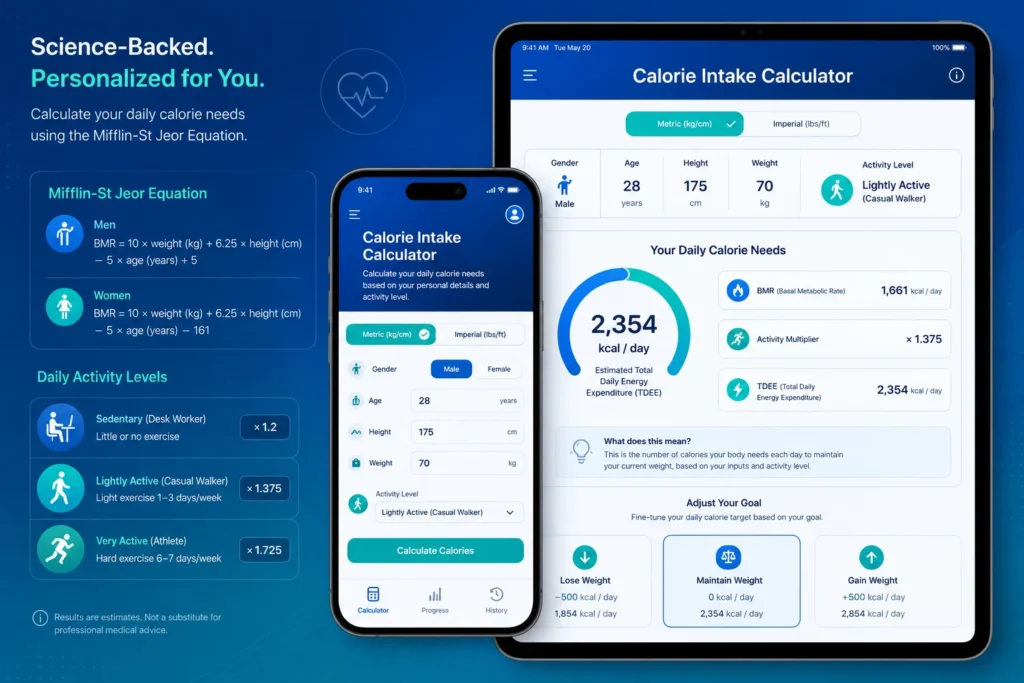
Generic dieting guides fail because no two human bodies expend energy at the exact same rate. Your daily calorie needs vary drastically based on a matrix of dynamic and static biological variables:
- Body Size & Composition: Larger bodies and individuals with higher percentages of lean muscle tissue natively burn more fuel, even when completely motionless.
- Age and Gender: Aging processes naturally shift muscle-to-fat ratios, while hormonal and anatomical differences mean men often require more baseline energy due to higher muscle mass components.
- Metabolic Profiles: Genetic predispositions, thyroid health, and hormonal balances introduce slight variations into your baseline metabolic speed.
- Physical Activity Level: Sedentary desk jobs require vastly lower energy inputs compared to rigorous workout regimens or heavy labor professions.
By utilizing a scientific calorie intake calculator, you efficiently translate these complex physiological elements into a clear, personalized, actionable daily target.
How the Calorie Intake Calculator Works: The Two-Step Science
The backend mechanics of a modern calorie intake calculator compress advanced metabolic science into two seamless, automated computational steps:
Step 1: Establish Your Basal Metabolic Rate (BMR)
First, the engine calculates your Basal Metabolic Rate (BMR). This represents the hard baseline number of raw calories your body burns at complete rest simply to keep your vital organs functioning. Think of it as the energy required to power involuntary processes like breathing, cell production, neurological signals, and blood circulation while sleeping.
Step 2: Apply Your Custom Activity Factor
Your body doesn’t remain at rest all day. To account for your lifestyle, your calculated BMR is multiplied by a highly precise activity factor. This multi-tiered scaling layer tracks your intentional exercise, casual daily steps, and work-related movement. The final number generated is your Total Daily Energy Expenditure (TDEE)—the ultimate metric for your daily calorie tracker needs.
The Mathematical Formulas Behind Calorie Calculation
To achieve an accurate scientific calorie calculation, algorithms rely heavily on the Mifflin–St Jeor Equation, which is widely regarded by clinical dietitians as the golden standard for estimating metabolic rates.
The calculator runs the following internal logic equations based on your gender:
$$\text{BMR (Men)} = (10 \times \text{weight in kg}) + (6.25 \times \text{height in cm}) – (5 \times \text{age in years}) + 5$$
$$\text{BMR (Women)} = (10 \times \text{weight in kg}) + (6.25 \times \text{height in cm}) – (5 \times \text{age in years}) – 161$$
Once your baseline BMR is established, the system processes your total daily energy expenditure by applying an optimized multiplier:
$$\text{Daily Calories (TDEE)} = \text{BMR} \times \text{Activity Factor}$$
Standardized Activity Level Multipliers
The calculator automatically assigns and processes one of the following validated activity scalars based on your direct inputs:
| Activity Level | Detailed Lifestyle Description | Scientific Multiplier |
| Sedentary | Little to no deliberate exercise; desk job lifestyle. | 1.2 |
| Lightly Active | Light exercise or sports 1–3 days per week. | 1.375 |
| Moderately Active | Moderate, structured exercise or gym sessions 3–5 days per week. | 1.55 |
| Very Active | Hard physical exercise or training 6–7 days per week. | 1.725 |
| Extra Active | Intense physical work, marathon prep, or athletic double-sessions. | 1.9 |
What Your Calorie Intake Result Means
Once the calculations conclude, the number provided represents your essential maintenance calories estimation. This value serves as your neutral metabolic balance point.
Understanding how to leverage this baseline number allows you to engineer three distinct body composition outcomes:
- Maintenance Calories (Energy Balance): Keeping your food consumption matched exactly with your TDEE keeps your body weight stable. This perfectly balances calorie intake against overall expenditure.
- Calorie Deficit (Weight Loss): By consuming fewer calories than your baseline maintenance target, you force your body to turn to stored body fat for energy. This deliberate shortfall sets your weight loss calorie target and leads directly to gradual, sustainable fat reduction.
- Calorie Surplus (Weight Gain): Consuming more calories than your maintenance threshold provides the surplus energy needed to synthesize new tissue. When paired with progressive resistance training, this surplus supports healthy muscle growth.
How to Use the Calorie Intake Calculator for Maximum Accuracy:
To extract the most reliable data out of your online evaluation, follow this structured, foolproof execution plan:
- Input Personal Metrics: Select your gender and input your current age accurately.
- Enter Exact Height and Weight: Input your body parameters. Our system is designed seamlessly for both Indian users comfortable with feet/inches and stones, as well as global users utilizing metric units like kilograms and centimeters. All conversions are handled flawlessly behind the scenes.
- Choose Activity Level honestly: Avoid the common error of overestimating your actual daily movement patterns.
- Process and Review: Click the calculate button to see your optimized macronutrient baseline planner foundations.
💡 Pro-Tip for Elite Accuracy: Your metabolism adapts as your weight changes. Make sure to update your weight inputs and recalculate your daily numbers every few weeks to prevent weight loss plateaus.
Real-World Limitations of Digital Calorie Calculators
While a calorie intake calculator is an invaluable baseline tool, it is crucial to recognize that software provides highly educated scientific estimates, not absolute laws. Real-life variables that can alter your true daily numbers include:
- Individual Adaptive Thermogenesis: Two people of the same height and weight can have slight metabolic variations based on past dieting histories or lean tissue ratios.
- The Dieting Trap: Extended periods of aggressive calorie cutting can cause temporary down-regulations in your natural resting metabolism.
- Human Error: Studies show most fitness enthusiasts unintentionally underestimate their food intake and overestimate their gym output.
Treat your initial calculation result as a highly intelligent starting point, not an unchangeable, rigid rule. Track your scale weight trends alongside your calorie counts and make adjustments as your real-world progress dictates.
Frequently Asked Questions (FAQs):
Is calorie intake identical to calories burned?
No. Calorie intake refers strictly to the chemical energy you swallow via food and beverages. Calories burned represents your TDEE—the energy your metabolism and physical movement consume to keep you alive and moving.
How accurate is this calorie intake calculator?
It delivers a highly reliable mathematical baseline using the clinically validated Mifflin-St Jeor formula. However, natural individual biological variations mean you should track your real-world results and make small adjustments over time.
How often should I update my calculator data?
It is best practice to re-enter your metrics every 3 to 4 weeks, or immediately after experiencing a noticeable drop or gain in scale weight.
Disclaimer: This digital tool and informational content are engineered for educational and awareness purposes only. It is not a substitute for clinical medical intervention, prescription dieting plans, or professional nutritional advice. Always consult with a qualified health professional before starting any aggressive physical or dietary protocol.