Fat Intake Calculator
Daily Fat Intake Calculator: How Much Fat Should You Eat Per Day?:
Dietary fat is an essential macronutrient required for hormone production, joint health, and sustained daily energy. Finding the right balance is critical: eating too little can disrupt metabolic health, while eating too much can easily cause an unintended calorie surplus.
If you are wondering how much fat you should eat per day, our daily fat intake calculator and fat needs calculator eliminate the guesswork. Instead of relying on generic percentage guidelines, this tool analyzes your individual weight, activity level, and specific fitness goals—whether you are aiming for weight loss, keto, or muscle building—to tell you exactly how many grams of fat to eat daily.
Track healthy fats easily with our precision macro planning tools.
Table of Contents
Why Calculating Your Daily Fat Intake Matters
Fats are highly energy-dense, packing 9 calories per individual gram—more than double the energy density of proteins or carbohydrates, which contain only 4 calories per gram. Because of this, small errors in tracking can significantly impact your progress.
When you use a daily fat intake calculator to optimize your nutrition, you ensure that your body receives vital fuel to handle crucial biological processes:
- Hormonal Balance: Fats serve as the baseline building blocks for vital hormones like testosterone and estrogen.
- Vitamin Absorption: Crucial micronutrients like vitamins A, D, E, and K are entirely fat-soluble, meaning your body cannot absorb them without adequate dietary fat intake.
- Cellular Integrity: Every cell membrane in your body relies on lipid layers for structural protection and cellular communication.
How to Calculate Daily Fat Intake: The Math Explained
Our daily fat calculator works by processing your body metrics through a logical three-step framework accepted by sports scientists and dieticians worldwide. Here is exactly how the math works under the hood.
Step 1: Establishing Your Basal Metabolic Rate (BMR)
Before finding your fat limits, the calculator determines your BMR—the baseline number of calories your body burns at complete rest just to keep you alive. We use the highly accurate Mifflin-St Jeor Equation to accomplish this:
- BMR for Men: (10 x weight in kg) + (6.25 x height in cm) – (5 x age in years) + 5
- BMR for Women: (10 x weight in kg) + (6.25 x height in cm) – (5 x age in years) – 161
Step 2: Calculating Your Total Daily Energy Expenditure (TDEE) and Goals
Your BMR is then multiplied by an activity factor to capture your actual daily movement:
TDEE = BMR x Activity Multiplier
The calculator uses standard industry activity settings:
- Sedentary (desk job, minimal exercise): 1.2
- Lightly Active (light exercise 1 to 3 days/week): 1.375
- Moderately Active (moderate exercise 3 to 5 days/week): 1.55
- Very Active (intense exercise 6 to 7 days/week): 1.725
- Super Active (hard physical labor or daily double workouts): 1.9
Once your base TDEE is found, the fat needs calculator shifts your calories based on your primary target:
- Fat Loss: Subtracted by 500 kcal to create a sustainable deficit.
- Maintenance: Remains unchanged.
- Muscle Gain: Increased by 500 kcal to provide a muscle-building surplus.
Step 3: Calculating Grams of Fat From Total Calories
Finally, your macro preference determines the final percentage allocation of your calories dedicated to fat:
- Lean / Low Fat Option: 25% of total calories
- Balanced Option: 30% of total calories (highly recommended)
- Higher-Fat Option: 35% of total calories
Because every single gram of fat yields exactly 9 calories, the calculator uses the following formula to output your final target in grams:
Daily Fat Intake (grams) = (Target Daily Calories x Fat Ratio Percentage) / 9
Real-World Example Calculation
To see this formula in action, let’s take an example of a 30-year-old male who is 170 cm tall, weighs 70 kg, is moderately active, and wants to maintain his weight at a balanced 30% fat ratio:
- BMR Calculation: (10 x 70) + (6.25 x 170) – (5 x 30) + 5 = 1,617.5 kcal
- TDEE Calculation: 1,617.5 x 1.55 = 2,507 kcal
- Goal Target (Maintenance): 2,507 kcal (rounded to roughly 2,500 kcal for baseline scaling)
- Fat Calorie Allocation: 2,500 x 0.30 = 750 kcal from fat
- Conversion to Grams: 750 / 9 = 83.3 grams of fat per day
Recommended Fat Intake Guidelines By Goal
| Fitness Goal | Recommended Fat Percentage Range | Ideal Macro Role |
| Fat Loss | 25% to 30% of daily calories | Preserves hormonal function while maintaining a necessary caloric deficit. |
| Maintenance | 30% of daily calories | Delivers optimal energy levels, performance, and day-to-day metabolic health. |
| Muscle Gain (Bulking) | 30% to 35% of daily calories | Easily packs in dense calories needed to meet muscle surplus requirements during bodybuilding phases. |
Managing Saturated Fat vs. Total Dietary Fat
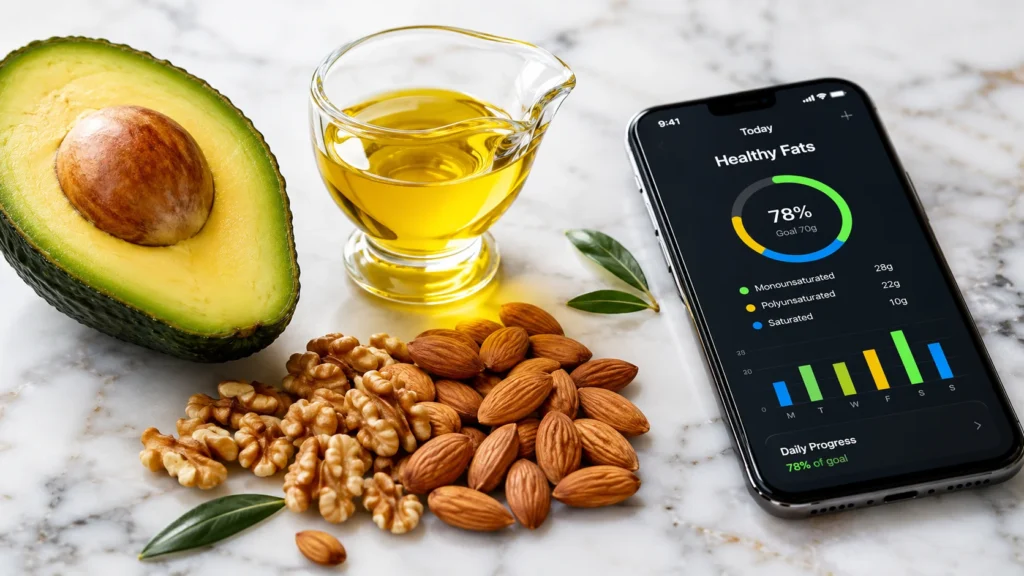
When tracking your macros with a fat gram calculator, it is important to distinguish between total fats and saturated fats. While monounsaturated and polyunsaturated fats (found in olive oil, avocados, and nuts) support heart and cellular health, health authorities generally recommend keeping saturated fats to under 10% of your total daily calorie intake to maintain optimal cardiovascular markers.
Common Pitfalls When Tracking Daily Fat Intake
When people attempt to optimize their nutrition without a reliable daily fat intake calculator, they frequently make critical errors:
- Dropping Fat Intake to Zero: Eliminating fats can lead to crashes in brain clarity, hair health, and vital hormone synthesis.
- Confusing Healthy Fats with Unlimited Calories: Avocados, nuts, and olive oils are incredibly healthy, but they are still calorie-dense. Overeating them will stall fat loss.
- Failing to Adjust as Weight Shifts: As your weight drops or increases, your BMR changes. You should recalculate your macros every 4 to 6 weeks using a fat needs calculator to keep your metrics aligned with your changing physique.
Frequently Asked Questions (FAQs):
What is a daily fat intake calculator?
A daily fat intake calculator is an interactive, science-based tool that calculates the exact amount of dietary fat you should consume every day. By analyzing your personal attributes like age, height, weight, and exercise habits, it translates your overall caloric target into a clear, actionable macro target in grams.
How do I accurately calculate daily fat intake for body goals?
To calculate daily fat intake, determine your total daily energy expenditure (TDEE) based on your activity level. Allocate 25% to 35% of those total calories to dietary fat depending on your preferences, then divide that calorie number by 9 to get the exact target grams you need to track.
How many grams of fat should I eat per day?
For most adults on a standard 2,000-calorie diet, recommended daily fat intake ranges from 44 to 78 grams per day. When using a fat needs calculator for fat loss, setting your dietary fat between 25% and 30% of your daily calorie deficit is ideal. This range keeps you fully satiated and keeps your hormones functioning perfectly without exceeding your fat loss caloric limits.
Can women use this fat needs calculator efficiently?
Yes. Our calculator utilizes the refined Mifflin-St Jeor equation, which incorporates distinct, gender-specific constants to account for the organic metabolic differences between men and women.
Does a fat intake calculator work for bodybuilding or muscle gain?
Absolutely. For muscle building, a daily fat intake calculator typically benchmarks your fat intake at 30% to 35% of your total calories. This helps you hit the higher caloric targets required to construct new muscle tissue without over-relying solely on massive quantities of carbohydrates.
What happens if your daily fat intake is too low?
Consuming under 15% of your calories from fat can lead to hormone imbalances, nutrient deficiencies, brain fog, and dry skin.