FHA Loan Amortization & Early Payoff Engine
| Milestone Target | Gross PITI | Principal Paid | Interest Paid | MIP Charges | Remaining Principal Balance |
|---|
Disclaimer: Core calculations represent approximate FHA MIP estimates. Actual underwriting guidelines fluctuate dynamically based on custom county baselines, exact institutional fees, and premium insurance rules.
FHA Loan Amortization & Early Payoff Engine: Save Thousands on HUD MIP
Navigating the mechanics of housing finance requires more than a standard monthly payment estimation. For millions of buyers leveraging Federal Housing Administration underwriting guidelines, the true economic trajectory of their debt is hidden inside the structural composition of their monthly payment breakdown.
Standard mortgage calculators frequently treat loans as generic amortizing structures. However, an FHA Loan Amortization & Early Payoff Engine must account for complex regulatory constraints, automated risk criteria, and multi-tiered insurance layers specified directly by the Department of Housing and Urban Development (HUD).
By mastering the mathematical lifecycle of your loan—and deploying an aggressive, strategic principal paydown protocol—you can disrupt standard long-term interest accrual, bypass trailing micro-decimal artifacts, and optimize your overall household balance sheet.

Table of Contents
1. The Anatomy of an FHA Amortization Schedule
Unlike conventional financing matrices where risk is primarily adjusted via custom private mortgage insurance premiums, FHA loans utilize a double-layered protection layout consisting of Upfront Mortgage Insurance Premiums (UFMIP) and Annual Mortgage Insurance Premiums (MIP).
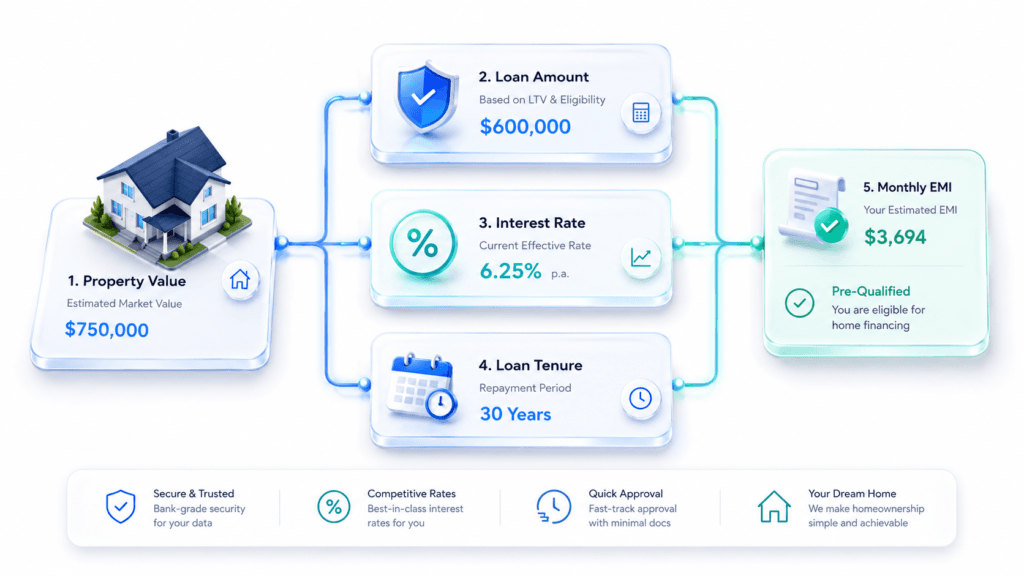
When your financing structure initializes, a regulatory fee of exactly 1.75% is levied as UFMIP. Rather than requiring this capital out-of-pocket at closing, the structural baseline engine typically synthesizes this fee directly into the core financing balance using the following calculation:
$$\text{UFMIP} = \text{Base Loan Amount} \times 0.0175$$
$$\text{Total Financed FHA Loan Balance} = \text{Base Loan Amount} + \text{UFMIP}$$
This immediate optimization impacts your compounding interest calculation from Month 1. Your contractual fixed rate executes against this newly inflated balance, altering the ratio of principal-to-interest distribution across the entire timeline of the loan.
To determine the fixed monthly Principal and Interest ($PMT$) payment running in the backend engine, the standard amortization formula is applied:
$$PMT = L \times \frac{r(1 + r)^n}{(1 + r)^n – 1}$$
Where:
- $L$ = Total Financed Loan Amount (Base Loan + 1.75% UFMIP)
- $r$ = Monthly Interest Rate (Annual Rate / 12 Months, expressed as a decimal)
- $n$ = Total Number of Amortization Months (Years $\times$ 12)
HUD Multi-Tier Annual MIP Matrix
The Annual MIP layer is not a flat structural addition; it functions as a fluid variable that adapts dynamically to your initial loan term, total financed amount, and Loan-to-Value (LTV) ratio. The annual mortgage insurance premium is split into 12 equal monthly installments inside the escrow account:
$$\text{Monthly FHA MIP} = \frac{\text{Total Financed FHA Loan Amount} \times \text{Rate}_{\text{MIP}}}{12}$$
For standard 30-year fixed strategies initialized with balances below or equal to the national floor tier ($625,500 baseline parameters), the operational premium percentages adapt as follows:
| Initial Base LTV Ratio | Annual MIP Rate | Regulatory Duration of Premium |
| > 95.0% (e.g., 3.5% down payment profile) | 0.55% | Life of the Loan (Full Amortization) |
| ≤ 95.0% (e.g., 5.0% or 10% down milestone) | 0.50% | Life of the Loan (Full Amortization) |
| ≤ 90.0% (e.g., 10%+ substantial capital injection) | 0.50% | Exactly 11 Years (Structural Dropoff) |
Additionally, property taxes and hazard home insurance are calculated based on the total home purchase valuation ($V_{\text{Home}}$) and split into monthly escrow portions:
$$\text{Monthly Property Tax} = \frac{V_{\text{Home}} \times \left(\frac{\text{Tax Rate}\%}{100}\right)}{12}$$
$$\text{Monthly Hazard Insurance} = \frac{V_{\text{Home}} \times \left(\frac{\text{Insurance Rate}\%}{100}\right)}{12}$$
To get the absolute initial gross monthly payment that hits your pocket, the engine sums every single one of these structural components:
$$\text{Gross FHA Monthly Payment} = PMT_{\text{FHA}} + \text{Monthly FHA MIP} + \text{Monthly Property Tax} + \text{Monthly Hazard Insurance}$$
💡 Expert Insight: If your baseline financing balance initializes with an LTV higher than 95%, the annual mortgage insurance layer cannot be removed via simple balance depreciation. The only true off-ramp to terminate this premium is an absolute refinancing transaction into a conventional matrix, or using an interactive principal payoff engine to force a rapid settlement.
2. The Mechanics of the Early Payoff Engine
Deploying an accelerated equity accumulation strategy relies on a simple mathematical rule: any capital injected over the baseline monthly obligation must be structurally isolated and applied exclusively to the remaining principal balance.
Every single month, the backend amortization loop breaks down your standard payment using two dynamic steps:
- Monthly Interest Accrual Component:$$I_m = B_{m-1} \times r$$(Where $I_m$ is current interest, and $B_{m-1}$ is the remaining principal balance from the previous month)
- Monthly Principal Reduction Component:$$P_m = PMT – I_m$$
Because interest calculates monthly based on your outstanding balance, reducing the principal balance immediately lowers the interest charge for the following period.
When you introduce an extra monthly principal buffer ($E_{\text{Extra}}$), the engine splits off an independent loop matrix to simulate an accelerated timeline, forcing a rapid balance update:
$$P_{\text{Accelerated}} = (PMT – I_m) + E_{\text{Extra}}$$
$$B_{\text{Accelerated}} = \max(0, B_{\text{Accelerated\_Previous}} – P_{\text{Accelerated}})$$
(Note: The $\max(0, \dots)$ formula acts as a critical safety floor to ensure the loan balance stops cleanly at zero and prevents trailing micro-decimal artifacts or negative numbers.)
Because your total baseline monthly payment remains contractually constant, a larger portion of your subsequent standard payment goes directly toward principal. This creates an exponential wealth retention cycle that compresses the duration of your loan.
Real-World Case Study: Compounding Interest Destruction
Let’s look at a typical home financing scenario tracked through an interactive amortization engine:
- Property Purchase Valuation: $375,000
- Down Payment Contribution: $13,125 (FHA 3.5% Underwriting Standard)
- Base Financing Balance: $361,875
- Financed Upfront MIP (1.75%): $6,332.81
- Total Initial Financed FHA Loan: $368,207.81
- Contract Fixed Interest Rate: 6.25%
- Standard Monthly Principal & Interest Payment: $2,268.49
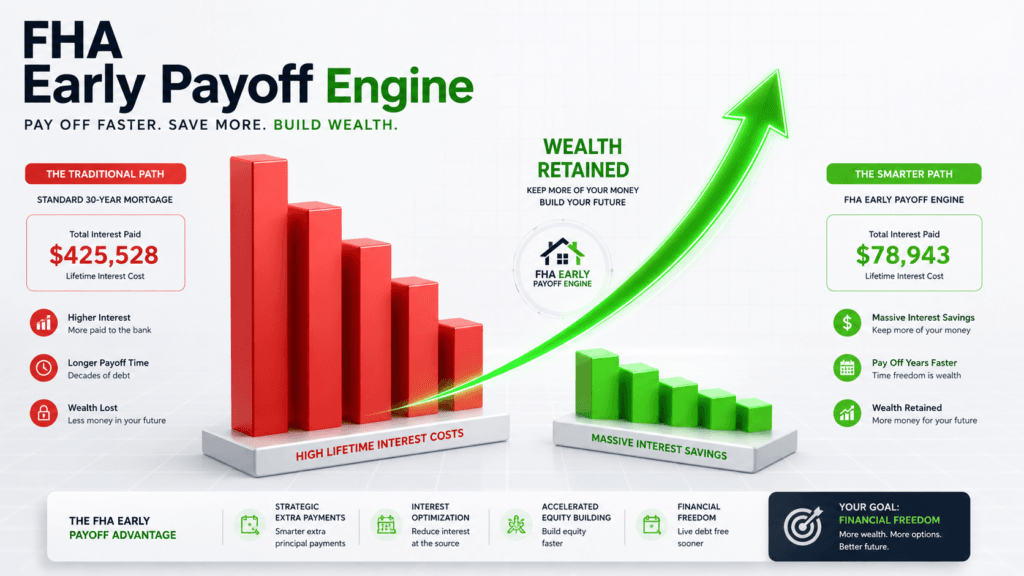
Without intervention, a standard 30-year schedule results in a long-term interest cost of $448,450.49, combined with a lifetime premium outlay of $60,753.84 for annual mortgage insurance.
Now look at what happens when you introduce a disciplined $200 monthly extra principal injection alongside an initial $5,000 one-time lump sum strategy:
| Optimization Metrics | Standard 30-Year Matrix | Accelerated Payoff Strategy | Total Wealth Retained |
| Total Loan Lifespan | 360 Months (30 Years) | 291 Months (24.25 Years) | 69 Months Saved |
| Cumulative Interest Charges | $448,450.49 | $341,202.10 | $107,248.39 Saved |
| Lifetime Annual MIP Cost | $60,753.84 | $54,321.40 | $6,432.44 Saved |
| Combined Lifetime Outflow | $509,204.33 | $395,523.50 | $113,680.83 Retained |
By utilizing targeted extra payments, the loan is paid off over five years early. This eliminates nearly $107,250 in interest charges and cuts $6,432 in ongoing annual insurance premiums before they can accrue.
3. Algorithmic Risk Factors & Underwriting Bounds
When building an investment strategy using an FHA loan, you must monitor several regulatory risk gates. Automated underwriting systems evaluate your profile using strict debt ratio thresholds, loan limits, and credit scores.
FHA Debt-To-Income (DTI) Matrix
Your Debt-to-Income ratio is one of the most critical gates in automated mortgage underwriting. It is split into two distinct components:
- Front-End DTI Ratio: The percentage of gross monthly income dedicated exclusively to the proposed housing payment (including baseline principal, interest, property taxes, hazard insurance, and annual MIP escrows).
- Back-End DTI Ratio: The percentage of income required to cover the housing payment plus all recurring, revolving consumer liabilities (such as auto loans, credit cards, student debts, and personal lines of credit).
┌───────────────────────────────────────────────────────────────────────────┐
│                    HUD AUTOMATED RISK APPROVAL MATRIX                     │
├───────────────────────┬───────────────────────────────────────────────────┤
│ Front-End DTI ≤ 31.0% │ Approved Under Standard Risk Criteria             │
│ Back-End  DTI ≤ 43.0% │                                                   │
├───────────────────────┼───────────────────────────────────────────────────┤
│ Front-End DTI ≤ 46.9% │ Requires Compensating Underwriting Factors        │
│ Back-End  DTI ≤ 56.9% │(e.g., FICO Score ≥ 620, Substantial Cash Reserves)│
├───────────────────────┼───────────────────────────────────────────────────┤
│ Front-End DTI > 46.9% │ High-Risk Profile: Subject to Manual Rejection    │
│ Back-End  DTI > 56.9% │                                                   │
└───────────────────────┴───────────────────────────────────────────────────┘
FHA Loan Limit Tiers
The Federal Housing Administration restrains its systemic liability by enforcing strict local county loan limits. If your base loan request pushes past these geographic boundaries, your application cannot be processed under standard FHA rules.
- Standard National Floor Tier: Designed for low-to-medium-cost housing markets, capped at $498,257 for single-family residences.
- High-Cost Regulatory Ceiling: Assigned to highly competitive real estate environments, extending up to $1,149,825.
- Special Regional Allocations: Specific geographic locations (such as Alaska, Hawaii, and Guam) feature expanded parameters scaling up to $2,300,000.
4. The Parity Cross: FHA vs. Conventional Analysis
A critical milestone in mortgage planning is identifying the Conventional Parity Crossover Year. This represents the exact point where the cumulative costs of an FHA loan pass the total costs of an alternative conventional loan.
Conventional loans require private mortgage insurance (PMI) if your down payment is under 20%. However, conventional PMI features an automatic off-ramp: it must be dropped by law once the principal balance hits 78% of the original property value. FHA mortgage insurance, by contrast, typically runs for the entire life of the loan.
While FHA loans often offer lower baseline market interest rates—making them highly attractive in years 1 through 7—the persistent drag of annual MIP means that a conventional alternative often becomes more cost-effective over a longer timeline.
Running an integrated amortization simulation helps you pinpoint this crossover year. This allows you to plan a strategic refinance into conventional financing right before your FHA loan enters its less efficient financial phase.
5. Implementation Guide: Setting Up Your Accelerated Payoff Strategy
To build an institutional-grade extra payment strategy without disrupting your personal cash flow, use this systematic checklist:
Step 1: Verify Prepayment Compliance
Confirm with your mortgage servicer that your additional payments will be handled correctly. While modern FHA loans are legally prohibited from carrying prepayment penalties, you must explicitly instruct your servicer to apply any extra funds directly and entirely to the principal balance, rather than holding them to cover future standard monthly payments.
Step 2: Establish an Inversion Buffer
Never compromise your household liquidity for illiquid home equity. Before injecting extra capital into your mortgage balance, make sure you have a standard emergency cash reserve. Equity inside a mortgage cannot be easily pulled back out without an expensive home equity line or a cash-out refinance.
Step 3: Automate Month-Over-Month Injections
Set up recurring payments through your banking portal to add a specific extra amount to your principal balance each month. Consistently adding an extra $100 or $200 per month is often more sustainable and effective than making large, irregular lump-sum contributions.
Step 4: Run an Annual Amortization Audit
At the end of each year, compare your actual remaining loan balance against your initial calculations. Use this data to adjust your strategy for the upcoming year, adapting to changes in your income, inflation, and your long-term refinancing goals.
Comprehensive Production Frequently Asked Questions (FAQs):
Q1: Can I pay off an FHA loan early to completely remove the monthly MIP fees?
Answer: Paying off your loan early completely eliminates future monthly MIP fees because it reduces the outstanding principal balance to zero. However, making partial extra payments will not remove the annual MIP if your initial loan-to-value (LTV) ratio was higher than 95% at closing. In that scenario, HUD guidelines state the insurance must remain for the full active lifespan of the loan. To completely eliminate MIP without paying off the home entirely, you must use your accelerated equity to refinance into a conventional mortgage once your balance drops to 80% or less of the property value.
Q2: How does the financed 1.75% Upfront MIP fee affect my long-term interest calculations?
Answer: Because the 1.75% Upfront MIP fee is typically added directly to your core loan amount rather than paid at closing, it increases your total starting debt. This means your fixed interest rate applies to a larger balance from day one. As a result, you pay interest not only on the money used to buy the home, but also on the financed insurance fee. This adds thousands of dollars in extra interest charges over a standard 30-year schedule.
Q3: What happens if my baseline financing amount exceeds the local county FHA loan limit?
Answer: If your requested loan balance exceeds local county limits, your loan cannot be approved through standard FHA systems. To move forward, you will either need to contribute a larger down payment to bring the loan balance under the local cap, or look into alternative financing options, such as a conventional mortgage or a jumbo loan.
Q4: How do extra payments lower my debt-to-income (DTI) underwriting ratios?
Answer: Making extra principal payments directly reduces your total outstanding debt over time, but it does not alter your contractually required standard monthly mortgage payment. As a result, making extra payments will not change your front-end or back-end DTI ratios for an active loan. However, reducing your principal balance allows you to reach an 80% LTV much faster. This makes it easier to refinance into a conventional loan with no mortgage insurance, which will lower your monthly payment and improve your DTI ratio for future financing needs.
Q5: Are modern FHA loans subject to prepayment penalty fees if paid off early?
Answer: No. Under current federal regulations and HUD guidelines, FHA loans are completely free from prepayment penalties. Borrowers can make extra monthly payments, pay large lump sums, or clear the entire balance at any point during the loan term without facing financial penalties or administrative fees.