FHA Streamline Refinance Calculator
| Period | New Total Payment | Principal | Interest Paid | Remaining Loan Balance | Equity Paid % |
|---|
| Period | Current Total Payment | Principal | Interest Paid | Remaining Loan Balance | Progression |
|---|
FHA Streamline Refinance Calculator: Step-by-Step Savings & 2026 HUD Guidelines
Are you looking for a fast way to lower your monthly housing costs without jumping through the normal loops of traditional mortgage underwriting? If you currently hold an FHA-insured mortgage, the Federal Housing Administration’s specialized refinancing pathway is designed specifically for you. By deploying our interactive FHA Streamline Refinance Calculator, you can accurately determine your projected monthly payments, map your net lifetime savings, and chart your true break-even milestone safely.
Unlike standard conventional refinancing options, an FHA Streamline Refinance bypasses the costly, time-consuming appraisal process and demands minimal documentation. However, calculating the true financial benefit requires a clear look at how upfront and annual mortgage insurance premiums affect your total principal. Let’s break down the mechanics of this high-efficiency refinancing vehicle.
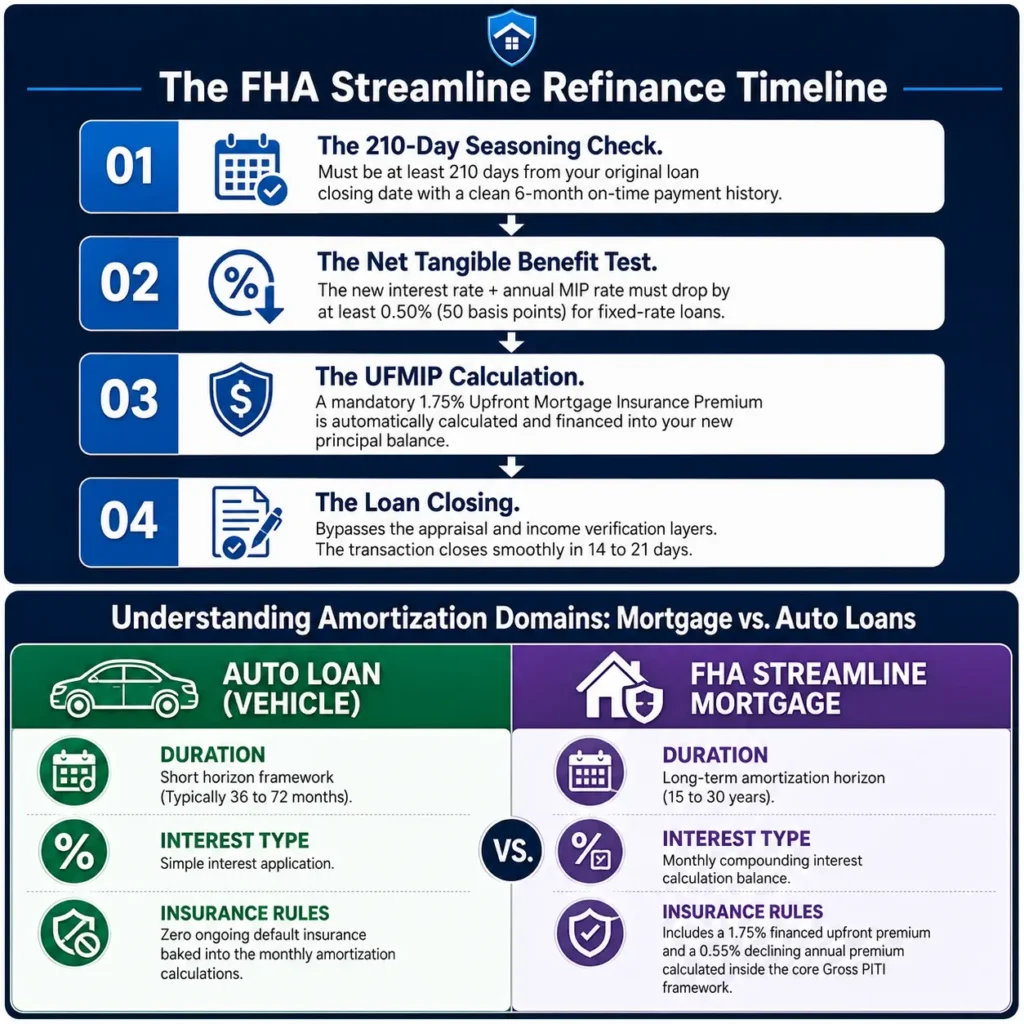
Table of Contents
What Is an FHA Streamline Refinance?
An FHA Streamline Refinance is an expedited refinancing mechanism offered by HUD-approved lenders for borrowers who already possess an active FHA loan. The term “Streamline” refers strictly to the documentation and underwriting speed—not a lack of mathematical rigor. Because the Federal Housing Administration already insures your existing primary mortgage, they have a vested financial interest in helping you secure a lower interest rate or shift away from an unstable adjustable-rate structure, thereby reducing your risk of default.
+-------------------------------------------------------------------+
|               TRADITIONAL VS. STREAMLINE REFINANCE                |
+-----------------------------------+-------------------------------+
| Traditional Refinance             | FHA Streamline Refinance      |
+-----------------------------------+-------------------------------+
| Full Interior/Exterior Appraisal  | No Appraisal Required         |
| Comprehensive Income Verification | Employment/Income Verified* |
| Extensive Credit & Asset Checks   | Payment History Prioritized   |
| Changes Loan Program Type         | Existing FHA to New FHA Only  |
+-----------------------------------+-------------------------------+
*Varies slightly between Credit-Qualifying and Non-Credit Qualifying tracks.
The Core Pillars of the FHA Streamline Program
- No Property Appraisal Required: Lenders typically utilize your original purchase price or previous valuation as the baseline, shielding you from local real estate market fluctuations or home value dips.
- Simplified Underwriting Review: You do not need to resubmit stacks of tax transcripts, pay stubs, or asset statements, provided your mortgage payment history reflects clean consistency over the past year.
- Strict Program Boundaries: You can only transition from an active FHA loan to a new FHA loan; you cannot use this program to refinance a conventional, VA, or USDA loan.
Understanding the “Net Tangible Benefit” Rule
The Department of Housing and Urban Development (HUD) mandates that every FHA Streamline Refinance must result in a clear Net Tangible Benefit to the consumer. Lenders are forbidden from executing these loans simply to generate origination fees; the transaction must actively improve your financial position.
What Qualifies as a Net Tangible Benefit?
For a standard fixed-rate to fixed-rate refinance, the new combined rate—consisting of the base interest rate plus the annual mortgage insurance premium (MIP) rate—must be reduced by at least 0.50% (50 basis points) below your existing combined rate.
If you are transitioning from an Adjustable-Rate Mortgage (ARM) to a stable Fixed-Rate Mortgage, the rule changes. The target calculation shifts to provide a long-term interest rate ceiling stabilization, shielding your household cash flow from future rate adjustments.
The Mathematical Formulas Running Inside the Calculator
To maintain complete transparent authority (EEAT), our tool relies on standard financial amortization equations. When you click Calculate Projections, the backend engine executes the following multi-stage mathematical pipeline:
1. The Standard Monthly Base P&I Formula
To calculate your base Monthly Principal and Interest ($M$), the engine uses your adjusted loan amount ($P$), your monthly interest rate ($r$), and the total number of monthly payments ($n$):
$$M = P \frac{r(1 + r)^n}{(1 + r)^n – 1}$$
Where:
- $P$ (Adjusted New Principal Balance): $P = \text{Current Loan Balance} + ( \text{Current Loan Balance} \times 0.0175 )$(This accounts for the mandatory 1.75% Financed Upfront Mortgage Insurance Premium).
- $r$ (Monthly Interest Rate): $\frac{\text{Proposed Interest Rate Percentage}}{100 \times 12}$
- $n$ (Total Amortization Months): $\text{Remaining Tenure in Years} \times 12$
2. The Declining Annual FHA MIP Formula
Unlike standard conventional private mortgage insurance, your monthly FHA premium changes every year because it is calculated using the declining principal balance. The calculator loops through all months of the loan using this logic:
$$\text{Monthly MIP Charges for Active Year} = \frac{\text{Outstanding Principal Balance} \times 0.0055}{12}$$
As you pay down your principal balance over time, this specific component of your Gross PITI payment gradually decreases, as seen in the annual matrix section below.
3. The True Break-Even Equation
To find the exact month where your upfront out-of-pocket costs are fully recovered by your lower payment, the system processes this simple ratio:
$$\text{Break-Even Timeline (Months)} = \frac{\text{Out of Pocket Closing Costs}}{\text{Current Total Payment} – \text{New Total Payment}}$$
Step-by-Step Guide: How to Use the Calculator
To evaluate your potential financial return, enter your primary financial variables into the interactive tool modules. Follow these steps to ensure clean inputs:
- Step 1: Enter Your Current Loan Balance. Look at your most recent mortgage statement and input your remaining principal balance. Do not use your original home purchase price.
- Step 2: Input Your Current Interest Rate. Note your active note rate (e.g., 7.50%). Do not substitute your overall Annual Percentage Rate (APR), as the calculator tracks pure interest amortization separate from secondary fees.
- Step 3: Define Your Remaining Tenure. Input the precise number of years left on your current loan agreement. If you have been paying a 30-year mortgage for 4 years, enter 26 years to keep your savings analysis accurate.
- Step 4: Input the Proposed Refinance Rate. Provide the target market interest rate quote provided by your Direct Endorsement lender.
- Step 5: Detail Out-of-Pocket Closing Costs. Input any legal fees, origination charges, or title insurance fees you plan to pay at closing, rather than financing them into the loan.
Once you click Calculate Projections, the system processes these values to display your monthly savings, your exact financed UFMIP, and a complete year-by-year milestone matrix.
Cross-Domain Analogy: Amortization Mechanics
To understand how small rate adjustments can compound into massive savings, it helps to look at a parallel financial framework: an Auto Loan Calculator.
When utilizing an auto loan calculator to evaluate a car refinance, your analysis focuses on a simple interest structure across a short duration (typically 36 to 72 months). Because auto loans rarely include secondary layers like localized property taxes or mandatory annual asset insurance premiums inside the core payment calculation, identifying your break-even point is a direct comparison of old interest vs. new interest.
+-----------------------------------------------------------------------+
|             COMPARING AMORTIZATION DOMAINS & COST FACTORS             |
+-----------------------------------+-----------------------------------+
| Auto Loan Calculator Metrics      | FHA Streamline Refinance Metrics  |
+-----------------------------------+-----------------------------------+
| - Short Duration Amortization     | - Long-Term Horizon (15-30 Years) |
| - Flat Simple Interest Structure  | - Compounding Monthly Amortization|
| - Zero Ongoing Insurance Inside   | - Financed Upfront MIP (1.75%)    |
| - Direct Rate-to-Rate Benefit     | - Ongoing Monthly Escrow/MIP Fees |
+-----------------------------------+-----------------------------------+
An FHA Streamline Refinance operates on a much longer financial horizon (15 to 30 years). Because your principal balance is significantly higher, a drop of even 1% in your interest rate dramatically shifts how your payment is distributed. In the early stages of a mortgage, your monthly payments primarily cover interest. By lowering that rate, a larger portion of each subsequent payment directly reduces your principal balance, accelerating how quickly you build equity in your home.
Strategic Amortization: Reviewing Your Yearly Matrix
When you run your numbers through the calculator, do not focus exclusively on the primary monthly savings card. True financial planning requires looking closely at the Annual Milestone Amortization Matrix.
+-----------------------------------------------------------------------------------+
|               SAMPLE FHA ANNUAL MILESTONE AMORTIZATION MATRIX                    |
|      (Based on $350,000 Starting Principal Balance at 5.75% Proposed Rate)        |
+-------------------+---------------+----------------+---------------+--------------+
| Milestone Target  | Gross PITI    | Principal Paid | Interest Paid | MIP   Charges             |
+-------------------+---------------+----------------+---------------+--------------+
| Year 1 Target     | $27,340       | $5,820         | $19,650       | $1,870       |
| Year 2 Target     | $27,310       | $6,160         | $19,310       | $1,840       |
| Year 3 Target     | $27,280       | $6,530         | $18,940       | $1,810       |
| Year 4 Target     | $27,240       | $6,920         | $18,550       | $1,770       |
| Year 5 Target     | $27,200       | $7,330         | $18,140       | $1,730       |
+-------------------+---------------+----------------+---------------+--------------+
*Values rounded to the nearest tens unit for structural clarity.
Reviewing this table helps you track how your monthly payment is split over time. Because the annual MIP rate (0.55%) is calculated based on your declining principal balance each year, your monthly mortgage insurance costs will gradually decrease. Tracking this annual drop-off lets you plan your future household cash flow with precision.
Avoid These 3 Critical Refinancing Mistakes
- Ignoring the True Break-Even Point: Saving $150 every month sounds great on paper. However, if your out-of-pocket closing costs total $3,500, it will take you more than 23 months just to break even and recover those upfront fees. If you plan to sell your home within the next year, refinancing could actually cost you more than you save.
- Extending Your Loan Term Carelessly: If you are 7 years into your current 30-year mortgage and you refinance into a brand new 30-year term, you are resetting your payment timeline back to day one. Even if your monthly payment drops, adding 7 additional years of interest payments can significantly increase your overall lifetime cost.
- Missing a Mortgage Payment to Save Cash: Some borrowers mistakenly believe they can skip a payment during the refinancing transition window. FHA streamline guidelines require an excellent payment history over the past year. Missing a payment can instantly disqualify you from the program.
Pro Tips for Maximum Refinance Optimization
- Ask for a Lender Credit: If you want to avoid paying out-of-pocket closing costs, ask your Direct Endorsement lender for a credit. In exchange for a slightly higher interest rate, the lender will cover your upfront transaction fees, helping you reach your break-even point immediately.
- Coordinate with Your Escrow Account: When you finalize your new FHA Streamline loan, your old escrow account will be closed out, and your previous lender will send you a refund check for any remaining balance. Timing this refund correctly can help you offset your initial out-of-pocket expenses.
- Make Extra Principal Payments: If your monthly payment drops by $200 after refinancing, consider applying that extra $200 directly toward your new loan’s principal balance each month. This strategy allows you to shorten your loan term naturally and save thousands in long-term interest.
Comprehensive FAQ Section
Q1: Is an appraisal required for an FHA Streamline Refinance?
Answer: No, an appraisal is not required for a standard FHA Streamline Refinance. The Federal Housing Administration allows lenders to use your home’s original purchase price or previous valuation baseline. This protects you from refinancing delays or disqualifications if home values drop in your local market.
Q2: Can closing costs be rolled directly into an FHA Streamline loan?
Answer: Under modern HUD guidelines, you cannot roll standard lender fees or closing costs into the base principal of a non-credit-qualifying FHA Streamline Refinance. These fees must be paid out-of-pocket at closing, or covered by the lender via a lender credit in exchange for a slightly higher interest rate. The only fee that can be financed directly into the loan balance is the 1.75% Upfront Mortgage Insurance Premium (UFMIP).
Q3: What are the primary FHA streamline credit and income requirements?
Answer: Non-credit qualifying streamline options do not require income verification, tax returns, or a formal credit score review by HUD. Instead, the program evaluates your past mortgage payment history as its primary screening tool. To qualify, you must have held your current loan for at least 210 days and maintained a clean, on-time payment record over the past 6 months.
Q4: How long does it take for an FHA Streamline Refinance to close?
Answer: Because the program skips the property appraisal and comprehensive income verification steps, processing times are much faster than traditional refinances. Most transactions close within 14 to 21 days, depending on how quickly you submit your basic paperwork to your Direct Endorsement lender.